What is BiodivAquArt?
The Aquatic Biodiversity in Art project (BiodivAquArt) is an interdisciplinary project in historical ecology at the crossroads of art and science, aimed at improving our understanding of past aquatic ecosystems. To do so, we use works of art as sources of information and testimony about aquatic fauna.
Through their creations, artists have left us valuable insights into how aquatic animals were perceived, caught, transported, sold, and consumed.
This information is analysed using tools from ecological statistics. By combining these data with historical and archaeological research, these paintings shed light on the long-term evolution of aquatic socio-ecosystems in Europe and the Mediterranean basin.
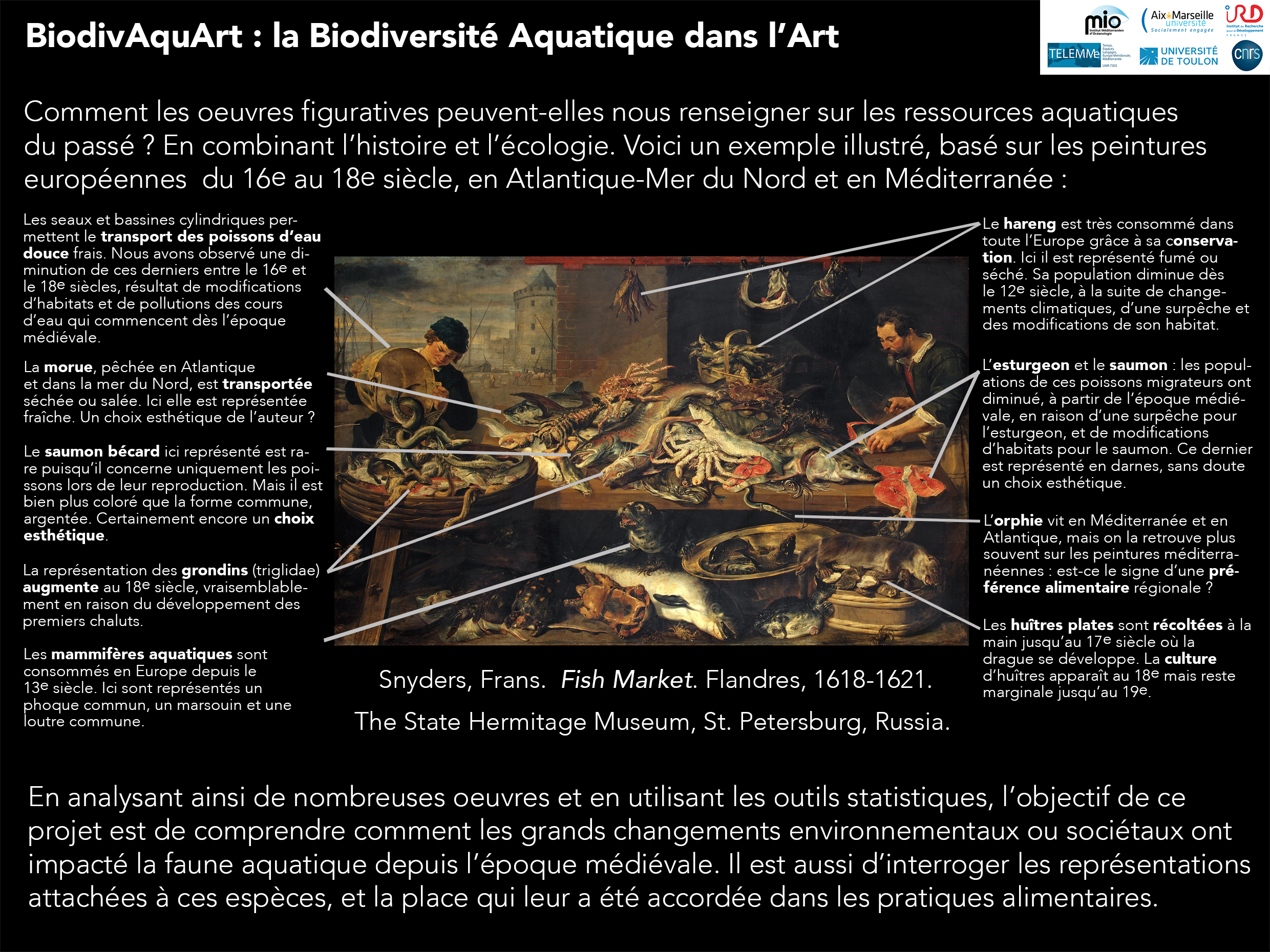
Here is, for example, a summary of the information drawn from a first study on paintings from the early modern period in Europe:
Click to enlarge
Associated papers:
Merquiol L., Tribot A.-S., Faget D., Denys G.P.J., Richard T., Changeux T. 2025. Italian still life paintings as a resource for reconstructing past Mediterranean aquatic biodiversity. Npj Biodiversity (4)1, p. 33. https://doi.org/10.1038/s44185-025-00103-8
Navarro L.M., Armstrong C.G., Changeux T., Frisch D., Gil-Romera G., Kaim D., McClenachan L. et al. 2025. Integrating historical sources for long-term ecological knowledge and biodiversity conservation, Nature Reviews Biodiversity. https://doi.org/10.1038/s44358-025-00084-3
Tribot A.-S., Faget D., Villesseche H., Richard T., Changeux T. 2021. Multi-secular and regional trends of aquatic biodiversity in European Early Modern paintings : toward an ecological and historical significance. Ecology and Society 26(4):26. https://doi.org/10.5751/ES-12740-260426
Tribot A.-S., Faget D., Richard T., Changeux T. 2022. The role of pre-19th century art in conservation biology: an untapped potential for connecting with nature. Biological Conservation, 276 : 109791. https://doi.org/10.1016/j.biocon.2022.109791
Tribot A.-S., Faget D., Changeux T. 2024. Nature experiences affect the aesthetic reception of art: The case of paintings depicting aquatic animals. PLoS ONE, 2024, 19 (7), pp.e0303584. https://doi.org/10.1371/journal.pone.0303584
Take part in the research!
To refine and enrich our analyses, we need your perspective. By sharing here the works of art you discover during visits to museums, galleries, or other cultural venues, you contribute directly to a collaborative research project.
To do so, simply create an account.
Click to enlarge
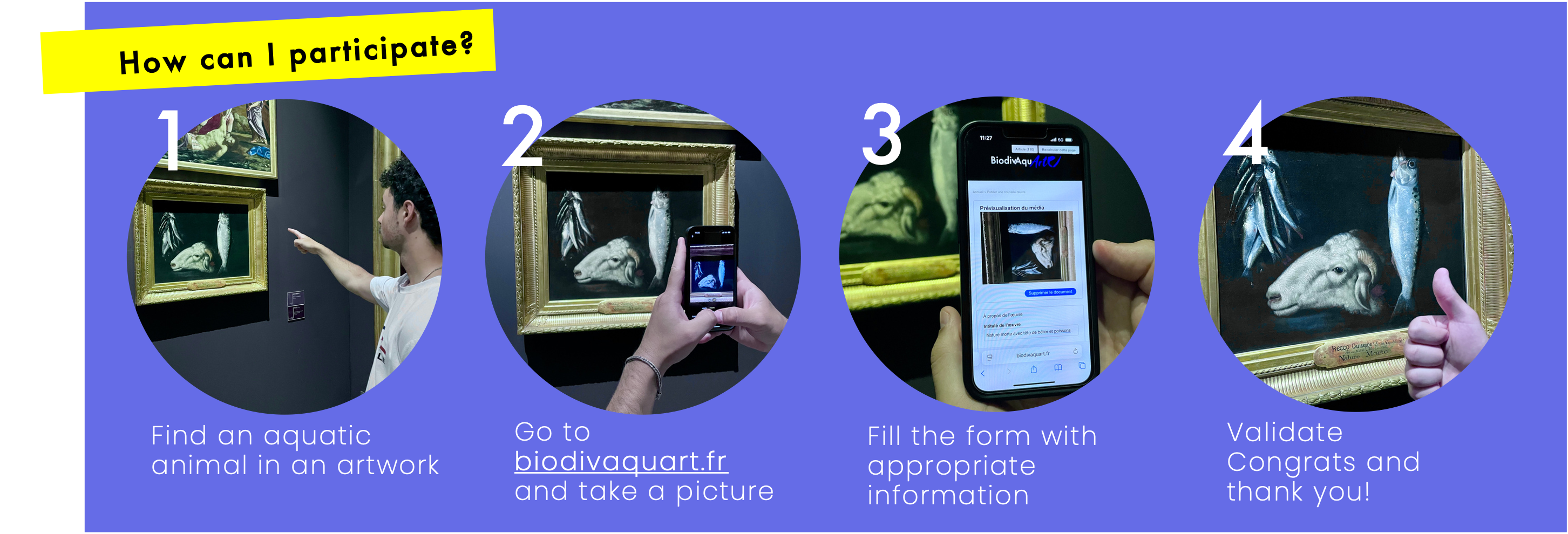
The works we are looking for depict aquatic fauna — fish, mollusks, crustaceans, and other species. For each contribution, a few key pieces of information are essential: the artist’s name, the geographical origin and period of the artwork, and the place where it is currently held.
Explore the contributions in the gallery.
What photos am I allowed to share here?
– All photos that you have taken yourself: when you photograph an artwork, you are free to share that photo online.
– Copyright-free photos: under licence CC-0 and CC-BY.
Example of analyses on paintings from the early modern period
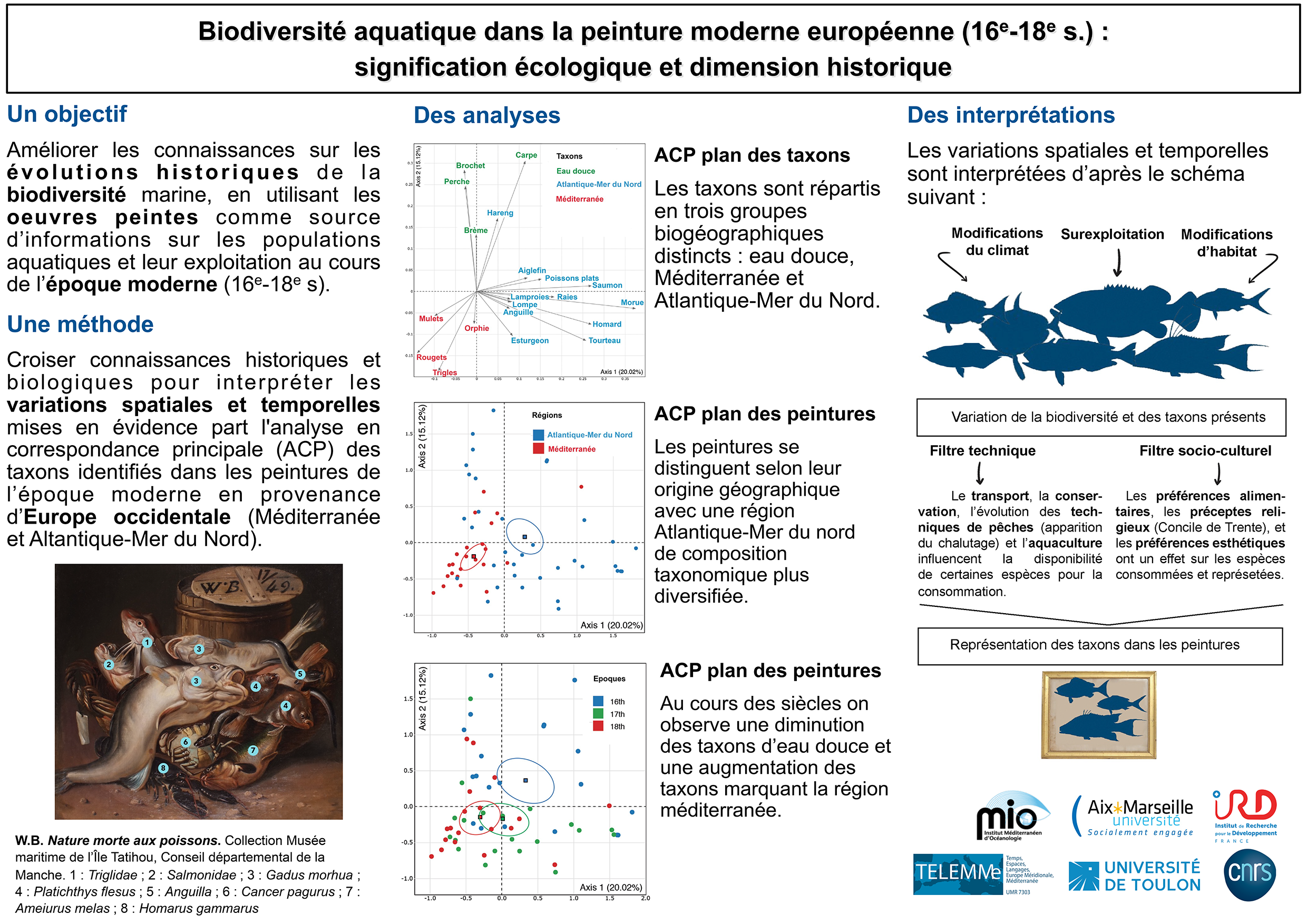
Here is an example of how the artworks you publish here are analyzed:
Click to enlarge
F.A.Q.
How are artistic representations collected?
To build our database, we gather artworks from existing digital databases, auction catalogues, museum contributions, and your submissions.
Species identification
First, we identify each species represented. Sometimes it is not possible to identify a species precisely (some are too similar to be distinguished in a painting). In such cases, we use taxonomy, which describes living organisms by grouping them into units called taxa, making it possible to describe, name, and classify them.
Statistical analyses
We then analyze how the representation of these taxa varies over time and space. Here, for example, we used a statistical method commonly applied in ecology: PCA (Principal Component Analysis), which groups individuals that appear in the same places and/or at the same times. This method was applied to both paintings and taxa in order to study their distributions.
Interpretation of results
Finally, we interpret these results by combining them with environmental, historical, and archaeological data. The aim is to understand how technical filters (transport, preservation, fishing techniques, aquaculture) and socio-cultural factors (dietary and aesthetic preferences, religious precepts) influence the representation of aquatic fauna in painting. These representations are also interpreted in relation to environmental changes, whether caused by humans (overexploitation, habitat modification) or by natural processes (climatic periods).
Project members and partners
Thomas Changeux: Hydrobiologist specialised in fisheries science. Mediterranean Institute of Oceanology (MIO) UMR 7294, Université de Toulon/Aix Marseille Université/IRD/CNRS, Marseille.
Daniel Faget: Historian, specialist in fisheries and marine biodiversity in the Mediterranean. TELEMMe (Temps, Espaces, Langages - Europe méridionale, Méditerranée) UMR 7303, MMSH (Maison Méditerranéenne des Sciences de l’Homme), CNRS/Aix Marseille Université, Aix-En-Provence.
Louise Merquiol: Ecologist and marine biologist, environmental history. TELEMMe (Temps, Espaces, Langages - Europe méridionale, Méditerranée) UMR 7303, MMSH (Maison Méditerranéenne des Sciences de l’Homme), CNRS/Aix Marseille Université, Aix-En-Provence & Mediterranean Institute of Oceanology (MIO) UMR 7294, Université de Toulon/Aix Marseille Université/IRD/CNRS, Marseille.
Anne-Sophie Tribot: Ecologist, aesthetic perception of biodiversity, Human–Nature relationships. TELEMMe (Temps, Espaces, Langages - Europe méridionale, Méditerranée) UMR 7303, MMSH (Maison Méditerranéenne des Sciences de l’Homme), CNRS/Aix Marseille Université, Aix-En-Provence.
Press articles
https://theconversation.com/une-breve-histoire-de-la-vie-aquatique-a-travers-la-peinture-238003
https://marcelle.media/2021/10/27/biodivaquart-traque-la-faune-aquatique-dans-les-oeuvres-dart/
Acknowledgments
We thank the museums that take part in the collection of artworks:
Les Musées de la Ville de Marseille, Musée maritime de l’Ile de Tatihou, Musée Fesch d’Ajaccio, Musée du Louvre de Paris, Musée d’Orsay de Paris, Musée des Beaux-Arts de Rouen, Musée Saint-Loup de Troyes, Musée des Beaux-Arts de Caen, Musée d’Art et d’Archéologie de Senlis, Musée Condé de Chantilly, Musée de Boulogne-sur-Mer, Musée Quentovic d’Etaples, Musée Sandelin de St-Omer, Musée d’Archéologie d’Antibes, Musée dArt Moderne André Malraux du Havre, Musée Picasso de Paris, Musée Goya de Castres, Musée Fabre de Montpellier, Musée des beaux-Arts de Nancy, Musée d’Arts de Nantes, Musée des Augustins de Toulouse, Musée des beaux-Arts de Valenciennes, MuséAl d’Alba-La-Romaine, Musée Archéologique Theo-Desplans de Vaison-La-Romaine, Villa Licinius de Clonas-sur-Varèze, Musée archéologique d’Eauze, Musée des Beaux-Arts et d’Archéologie de Besançon, Musée de la Romanité de Nîmes, Musée d’Art et d’Archéologie de Valence, Museu Nacional d’Art de Catalunya, Museo Bellas Artes de Sevilla, Museu de Belles Arts de Valencia, Museo Nacional Thyssen-Bornemisza, Parco Archeologico di Lilibeo-Marsala, Consorcio Ciudad Monumental de Mérida, Galleria dell’Accademia di Venezia, Galleria Estense di Modena, Musei Vaticani, Museo Archeologico Nazionale di Aquileia, Museo Archeologico Regionale di Agrigente, Museo Archeologico Regionale Antonino Salinas di Palermo, State Hermitage Museum of St-Petersburg, Rhode Island School of Design Museum, Brooklyn Museum et Metropolitan Museum of Art of New-York.
We also thank the experts who contribute to taxonomic identification:
Members of l’Institut Méditerranéen d’Océanologie (MIO), GIS Posidonie, Museum National d’Histoire Naturelle, UMR CReAAH, Université de Montpellier, Université de Nantes et Stazione Zoologica Anton Dohrn.
Contact
contact@biodivaquart.fr